Tuesday, 29 June 2010

New vegetables in season now!

 My last trip to Waitrose revealed that two new vegetables appear to have come into season; peas and marrow.  Now, I use peas in quite a lot of my cooking, as you might have noticed from one or two of the pictures here...  But, they are nearly always frozen peas.  Frozen peas are great because they are frozen very quickly after being picked, which means that they maintain a lot of the vitamins and minerals that makes them so good for you.  Peas are also a good source of fibre, with 100g of peas containing as much as 5.1g of fibre! (http://en.wikipedia.org/wiki/Peas).  However, the fresh peas have a completely different flavour, even if you do need to go through the hassle of shelling them yourself:

 I think they are easily worth the effort as they taste so much sweeter and crisper than the frozen ones.  I use them either as I would with frozen peas (boil in lightly salted water for 3 minutes), or just leave them raw and have them in a salad or something similar.
 I also noticed that marrows seem to be in season now, so I shall post something about the marrow when I've decided what I am going to do with.
At this time of the year, when there are so many good, fresh vegetables available, it seems almost a shame to be eating too much meat.  So, an unplanned consequence of my EatingBritish diet is that I've really cut down on my meat consumption during the summer months.  When I cooked before starting this project, I tended to rotate through the same dishes on a near weekly basis (very boring!).  However, now that I am basing my cooking on what I find to be the freshest and the most in season at the shops, I am finding that my diet has become a lot more varied.  Meat is a great source of protein and other things that the body needs, but I think it really comes into its own during the late autumn and winter months, when there simply isn't that much available on the vegetable front.  It occurred to me today that, in the UK at least, we have an unprecedented amount of choice when it comes to the food we buy, on a level probably never known by any previous generations.  Yet, despite this, how many people sit down to the same meal on a regular basis?  How many people really vary their diet that much beyond just a few recipes?  I suspect not many.  The odd thing is that when I started this project, several people objected to it because they saw modern food and cooking as being about variety.  However, in my attempts at sticking to a diet of only food produced in Britain, far from reducing the variety of my diet, I have increased it significantly.

Monday, 14 June 2010

Seasonal produce

After all the fuss I made about the regional produce I bought in Waitrose last week, I thought it was probably time that I wrote a little more about it.  In the end, once I'd sampled some of the vegetables raw, I realised that they were far to fresh to be cooked to death in some complicated dish.  When vegetables (technically, tomatoes are a fruit of course...) are this fresh, I think it's almost a crime to cook them beyond the bare minimum.  The spinach and the asparagus in particular seem to really benefit from actually being in season at the moment, you can really taste it.  So, one super simple dish that I like to do when I get home from work and am hungry and in need of something fairly quick is to just basically cook some pasta and add some olive oil, freshly ground black pepper, course sea salt and the freshest vegetables available.  This could be done with almost any vegetables really, but in this case I used asparagus, mushrooms and spinach.  This dish is perfect when the vegetables are so fresh because they are not really cooked at all, just warmed through.  The end result should look something like this:

 This really is the simplest thing to prepare.  Put the pasta into little salted, rapidly boiling water.  While it's cooking, wash the vegetables.  Slice the mushrooms and the asparagus.  When the pasta is nearly done, add the slices asparagus for no more than three minutes, it takes a bit of practice to get the timing for the pasta right, but it's worth persevering.  A time saving trick I like to use is to wash the spinach leaves in a colander under the cold tap.  Once the pasta is cooked, drain the pasta through the same colander, leaving the spinach in.  This way, the pasta gets drained and the spinach gets steamed by the hot water!  Nice.  Tip the pasta and the spinach back into the saucepan, add olive oil, freshly ground black pepper and course sea salt.  Stir it around and add the mushrooms.  That's it!

 We've been having a lot of warm and wet weather just recently, which of course has done wonders for my attempts to grow my own food:


 As you can see, the tomatoes are coming on well, the mint is progressing but is still too small to use really.  Unfortunately, the sweet peppers are not doing much and appear to have been munched by snails.  However, the alpine strawberries are doing well, though I am surprised that they haven't produced any flowers yet.

Tuesday, 8 June 2010

Waitrose Regional Foods

I've just got back from doing my shopping at Waitrose, which happens to be my closest supermarket, although I do occasionally go to others.  Waitrose have quite a strong focus on local produce and actually have a whole section, albeit a small one, devoted to regional, local produce.  In my case, the region in question is 'South of England'.  As I say, it's only a small section so there isn't all that much there, but they usually have locally produced potatoes and mushrooms here.  Today, I also got organic spinach, plum tomatoes and asparagus.  I feel that although the selection is small, I have to do my bit by supporting this initiative.  If more consumers buy these products, the supermarkets will release that this really is something that we want to be able to buy and hopefully that will lead to an increase in the range of local produce available.  I occasionally go to farm shops and I would like to start using some smaller, local suppliers for things such as meat.  The trouble is, it is very hard to beat the convenience of a supermarket.  To get to a farm shop, I have to use my car, whereas I can walk to Waitrose.  There are one or two smaller, local shops I can drop into on my way home from work, so I shall have to explore that possibility.  The point I am trying to make I guess is that it isn't always possible to do your shopping at farm shops and small local suppliers, but at least if you're going to use a supermarket, try to support any local food initiatives they may have.  I am sure all the main supermarkets have similar local producer schemes to Waitrose.

Fish and chips

Personally, it always annoys me slightly that whenever you ask someone to think of an example of British food, the first thing they'll almost always say is fish and chips!  Whether we like it or not, I guess this dish has become the icon of British food.  According to the Wikipedia article, Fish and Chips as a dish originated in the UK in either 1858 or 1863, so it's certainly been around for sometime.  It is actually quite hard to think of another, similarly iconic British dish, unless you start thinking of Chicken Tikka Masala and that sort of thing.
Anyway, I felt that I wanted a change from my usual boiled potatoes the other day, so I set about making my own chips, which I had with a salmon fillet, so this isn't your classic fish and chips dish by any means.

 So, to make chips, first cut a large potato into chip-like shapes.  This was actually a baking potato and I know that 'professional' chip makers think that the variety of potato makes a huge difference to the quality of the final chips.  They are probably right and I think a lot of it has to do with water content, with a higher water content being better.  These were Estima potatoes, grown in Suffolk and they seemed to work well.  I deep fried them in olive oil, keeping the heat below the smoke point of the oil.  Now, I could have used the cold pressed rape seed oil which I've used for various things here before, perhaps I should have done really given that it's British, but it is also quite expensive!  Of course, it's smoke point is much higher than that of olive oil, which may have made it better, but to be honest, the olive oil seemed to work quite well.

 I let them fry, stirring them around occasionally, until they just started to brown.  I then removed them from the oil and allowed them to cool completely, which took about 20 minutes, before putting them back in the hot oil for another 15 to 20 minutes to finish off.  It is really important to let them cool completely like this if you want them to be crispy on the outside and nice and soft and fluffy on the inside!  It takes a bit of time, but it's worth it.

 So, after letting them cool (as shown in the above picture), I fried them again to give the finished result:

 They really were extremely good, even if I do say so myself!  The crispy outside layer had swollen up and separated from the fluffy inside on many of them, which gave them the most delightful texture.  The olive oil also seemed to impart a good flavour.  Of course, you always need to be careful deep frying things like this, but I used the absolute minimum amount of oil in the pan and had a damp dish cloth ready in case of a fire!  I'd recommend that you do the same if you try making chips this way.

Wednesday, 2 June 2010

Fine food over the weekend

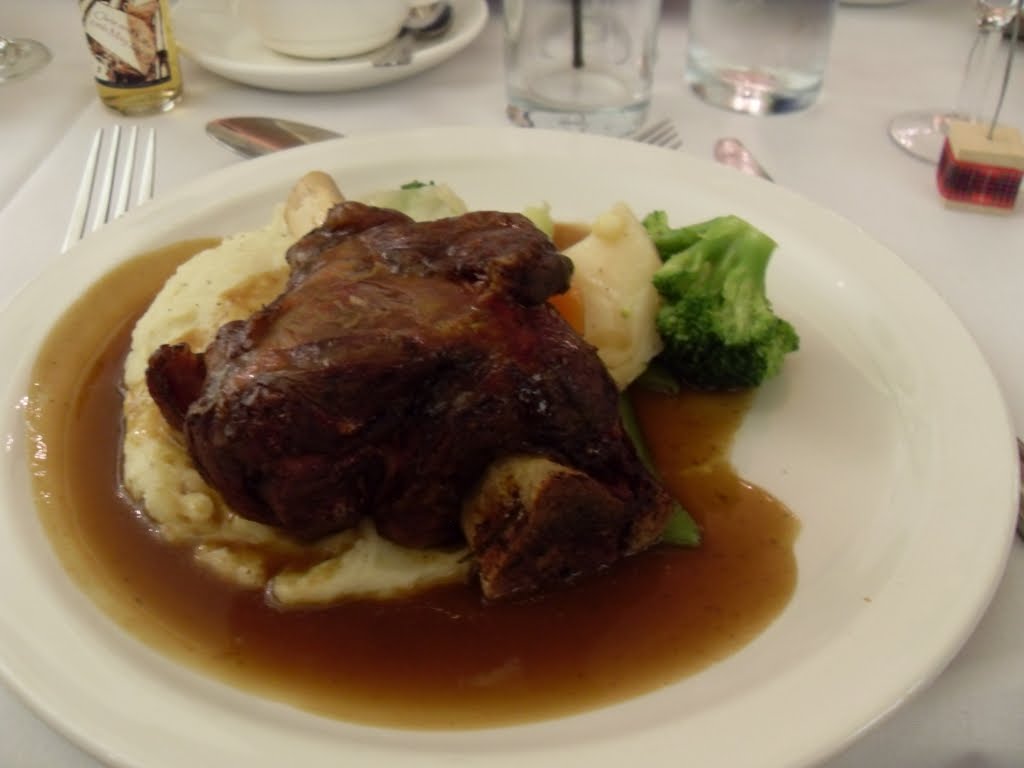
 I had the great pleasure of attending a friend's wedding last weekend.  Weddings are always good fun for many reasons, but one is nearly always treated to particularly good food and this was no exception!  Of course, it was great to see all my friends and to catch up, but of importance here is the food, so I'll get straight to the point!  To start, we had crab cakes which were made with flaked crab meat coated in bread crumbs and served on a bed of rocket salad.  The salad was dressed with what I suspect was a balsamic dressing, which was very good.  Unfortunately, I didn't get any good pictures of these unfortunately.  The main course was lamb shank, which I did get a good picture of:

 Lamb usually makes for a great dish and this was no exception!  Here, it has been served on a bed of mashed potato with broccoli.  It was very good, the meat was perfectly cooked and simply fell off the bone, just as it should.  Dessert was Eton mess, again unfortunately I failed to get a good photo, but it was also excellent.

 The wedding food aside, one other dish of note from the weekend was a pizza I had a Fire & Stone in Oxford:

 This was a Peking Duck pizza!  That's a first for me, I'm more used to the usual ham and mushroom or pepperoni, so I couldn't resist the chance to try something a little more exotic.  It was amazing!  Thoroughly recommended.  Actually, Fire & Stone had a huge range of exotic pizzas, so they are definitely worth checking out in my opinion.

Wednesday, 26 May 2010

Home grown food

 In my last post I promised to blog about my latest efforts to grow some of my own food.  As I don't have a garden, I am slightly limited in what I can grow, but I think you can do quite well with just a patio.  So, here are some of the things I am growing this year:

 Last year I grow a few tomato plants in a grow bag, which worked really well, but I thought that this year I would go for something that looked a little better!  I think the pots provide a bit more flexibility as well as you can move them around and arrange them more easily.  Anyway, I have two tomato plants, of different varieties, so hopefully they'll do well.


 These are radishes, which are really very easy to grow and make an excellent salad vegetable.  They grow quickly, particularly  in the hot weather we've been having recently, so I am keeping a couple of pots going planted some time apart.  I hope that this will allow me to have an extended supply of radishes, though continuous would be even better.

 These will be spinach fairly soon...

 This is regular garden mint, which I find is superb for making fresh mint tea!  It's a bit too small at the moment, but when there is enough of it, the thing to do is to simply cut a short branch, wash it, put it into a mug or a cup and pour boiling water of it.  This makes a suitably refreshing hot drink for the hot weather!

 I also planted some Alpine strawberries, which are those really small berries you sometimes see in the shops.  They may be small, but they have a lot of flavour, so hopefully these will turn out well!

 And these are red peppers!  To be honest, I'm not sure how well these will do but I bought them as seedlings from the garden centre and the label said that they were ideal for patios...  It will be exciting if they do produce fruit, but I tried growing sweet peppers indoors last year and it wasn't very successful. 

 I've got space for quite a few more pots, so if I have time I shall be making some additions.  The great thing about using pots is that, once planted, they are really low maintenance, except for needing watering and the occasional feed.

Tuesday, 18 May 2010

British air dried ham and early season asparagus

 Dear Readers!

 I must apologise for the rather long break I've had from the blog!  But, do not dispair, I have not given up on the project.  April turned out to be a rather hectic month and I ended up getting stuck in Canada because of the Volcano and, well, lot's has been happening, so unfortunately the blog took a back seat there for a while.  Anyway, I'm back now and there is quite a lot of catching up to do!

 My regular readers will remember that I did quite well with growing tomatoes last year on my little patio.  Well, I'm trying to do even better this year and have gone all out and got some nice pots.  I'm trying to grow all sorts of things this time round, including radishes (which have to be the easiest to grow vegetable ever!), spinach, spring onions (though they're not looking so good), tomatoes, mint, thyme, lemon thyme, rosemary, sage, corriander and alpine strawberries.  I shall post some pictures of all of this at some point in the near future and will of course keep you up to date with my progress!

 Anyway, today I'd like to blog about the British air dried ham that I bought at Richard Woodall's butchers in the Lake District some time ago.  I finally got around to using it!  This ham is very much like Palma ham from Italy, if you've had that and as such goes very well with asparagus.  Now, of course, asparagus is in season right now (make the most of it, it's a short season!), so I thought that this would make the perfect combination.

And the ham:

Now, this is really easy to do!  I've found that many people will say that they don't like asparagus, but I often find that this is because they have never had it when it has been cooked properly.  All too often, it's served after having been boiled and it has turned to nothing more than a slightly strange flavoured green mush.  This is not good!  Asparagus must be cooked gently in my opinion, or very quickly on a high heat.  So, grilling works well, or the BBQ!  However, in this case, I've opted for boiling in lightly salted water. 

Trim the woody part off the bottom of the stalk, but otherwise they should need no preparation beyond washing.  Get the water boiling rapidly and then add the asparagus and start a timer.  I let it boil for as close as possible to three minutes and then whip it out as fast possible onto some kitchen paper to dry off.  For this dish, I then allowed it to cool, before carefully wrapping each stalk in a piece of the ham, like so:

 Personally, I think this is a fantastic combination and it seemed to work very well with the Richard Woodall ham.  However, aware that nobody should simply take my word for it, I took some to work and shared them around with my work collegues.  It seemed to go down very well!