Wednesday, 27 January 2010

Roast vegetables and Venison Burgers

Many winter vegetables, such as parsnips and carrots are almost unbelievably good when roasted! Even if you don't like these vegetables boiled or raw, I'd suggest given them a try this way. Here, I've roasted some carrots, parsnips and shallot onions.

I sliced the parsnips length wise into halves and did the same with the larger of the carrots - the smaller ones can be left as they are. I peeled the shallots, but otherwise left them whole. Simply place the lot in a baking tray or roasting tin and cover liberally with oil. I used cold pressed rapeseed oil, which has a wonderful yellow colour and a good flavour for this kind of cooking. However, olive oil would work well to. Add a good sprinkling of salt and pepper and then place in the oven at 180C (I don't know what gas mark that is, sorry!) for about 40 minutes, or until you can push a fork into the parsnips fairly easily. The end result should look something like this:

I used my roasted vegetables to go with pan fried Venison burgers, which I simply did in the frying pan over a moderate heat and served with boiled potatos.

Wednesday, 20 January 2010

Baby Cabbage


I came across these during my latest trip to the supermarket. I haven't seen these before and they are British, so I thought I'd have to give them a try. I've only used one so far, just in a simple dish with spaghetti similar to one I've blogged about before (click here to see it). They are slightly sweeter then a fully grown cabbage and have a really nice, firm texture. Actually, it tasted really rather good! Looking more closely I think shows all the signs to look for when choosing a nice, fresh cabbage:
The colouring on this leaf is just perfect! It looks really rich and inviting and there is a healthy sheen to the stalk. This is what fresh cabbage should look like, not the limp, dull, lifeless things you often see.

Anyway, I did rather well for British vegetables this time round, as you can see:

Vegetable Grown in
Baby green cabbageLincolnshire
Baby Chantenay carrotsNottinghamshire
Curly kaleLincolnshire
ParsnipsSuffolk
ShallotsLincolnshire
LeeksCambridgshire

This really is a good season for British vegetables!

Friday, 8 January 2010

Cavolo Nero Cabbage, Sprouts and Bacon with Spaghetti

After all my talk in my last post about making shopping more adventurous by selecting products based on what is most local and most fresh, I thought it would be good to show something of an example. This approach to shopping really works best for vegetables and in fact I would go as far as to say that it is the best way to buy vegetables.

So, on a typical trip to the supermarket, I will hunt around in the vegetable section to see what's good and what's not, adding things to my trolley based on freshness and and how local it appears to be. Once I feel I've investigated everything on offer, I usually have a good selection in the trolley. At this point, I'll sometimes put one or two items back if it looks like I've got more than I'll need to last me a week and make a mental note to look for them again next week. Having chosen the vegetables, I will then choose what meat to buy based on the vegetables that were available, rather than the classic method of having a pre-set menu in mind before reaching the shop.

Now, I don't deny that this approach to shopping does take longer, but I still manage to do it in the evening after getting home from work, so it really isn't too bad. Sometimes other, more focused, shoppers get a bit irate at me for constantly going backwards and forwards in the vegetable section rather than following the unwritten (and unsigned) rules for correct supermarket navigation. But, I find that by taking a little longer over the shopping, it actually becomes a more enjoyable experience and I leave the shop significantly more relaxed than if I'd been barging around.

My last shopping trip was a great example of the benefits of this process. I found two vegetables that I haven't cooked with before, both of which are British produce. These were Jerusalem Artichokes, which I'll come back to in a later post and Cavolo Nero cabbage. The cabbage just looked really exciting! It's a very dark green colour, almost black in places. It has very long, narrow leaves and the packet informed me that it was originally from Italy but is now grown in the UK. So, I couldn't really resist getting some to give it a try in something. I also picked up some spouts, also UK produce, which are really good value at the moment – I got 50% extra free! I heard somewhere that there was something of a glut in sprout production this growing season, so suppliers have been selling them off cheap to try to get rid of them. I don't know how true that is, but they do seem to be exceptionally good value at the moment, for whatever reason.

There is a very simple and very quick recipe that I find is great for using winter greens, such as cabbage, spinach or indeed spouts. I'm not entirely sure what to call it really, so I won't give it a name beyond the one I've put as the title for this post, which says precisely what it is. Wash and chop about 5 or 6 leaves of the cabbage and remove the stalks and outer leaves from a handful of sprouts. At this point, put some spaghetti into a pan of lightly salted, boiling water. The pasta I use takes about 8 to 10 minutes to cook, which is just perfect for this recipe. Chop some bacon and then fry in a little vegetable oil until it starts to go crispy at the edges. Add the cabbage and continue to fry on a high heat until it starts to wilt, stirring it around occasionally. Then, add the halved spouts and continue stirring it around for another couple of minutes. Once the spaghetti is done, drain the water away and return the pasta to the pan. Liberally pour over some extra virgin olive oil and stir it around to make sure the pasta doesn't stick together or to the sides of the pan. Add the fried bacon, cabbage and spouts and stir around. Finally, I really like to add a generous portion of pine nut kernels, which are almost certainly not British, but I just love them! I like to add a little course sea salt and some freshly ground black pepper as well. Stir it all around in the pan once or twice and then serve immediately. This really is a very fast dish to prepare – it can be done in only the time it takes the water in the pan to come to the boil and the pasta to cook through.

Wednesday, 6 January 2010

Happy New Year!

Firstly, I would like to wish all my readers a really great New Year for 2010! May your year be full of wonderful culinary treats.

Many people may well be thinking more about dieting and cutting back on the food at this time of the year, after the over indulgences of the Christmas season. Personally, I think there is always room for good food, but if you are dieting at the moment then I really do wish you the very best of luck!

I don't really go in for new year's resolutions much myself, but if I did one I would make would be to try even harder through 2010 to explore local and British produce. I'd like to think that some of my readers may have been inspired to do something similar. Ingredients, in particular vegetables, always taste better the fresher they are. This is one of the reasons why vegetables you've grown yourself always taste better – you can't get much fresher then something pulled or picked and used within minutes. It stands to reason that the further vegetables have to be transported, the less fresh they will be and the less fresh they are, the less tasty they will be. Put simply, locally produced food such as vegetables, will be tastier than those grown hundreds of miles away.Of course, the availability of local vegetables is subject to the seasons, so it might be hard for someone who is used to cooking the same recipes over and over throughout the year. There isn't necessarily anything wrong with this and it should be possible to use local ingredients for at least part of the year. But personally, through doing the EatingBritish thing a while back and by continuing with this blog now, I find that my shopping habits have changed significantly. I still do most of my shopping at the supermarket, simply for the convenience really. However, instead of going along with a fixed menu for the week ahead, I go with an open mind and choose the ingredients that are the most local and the most fresh. In this way, the diversity of my cooking has increased enormously! And, it really adds some excitement to a shopping trip because it becomes something of an adventure. The adventure doesn't stop in the supermarket though, it continues in the kitchen when you get back home as you explore a new ingredient. If you've never tried shopping this way before, perhaps I could suggest that you make a, slightly late I admit, new year's resolution to try at least once in a while!

Wednesday, 4 November 2009

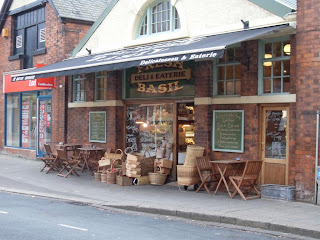
Fresh Basil Cafe, Belper

Gosh, it's been a while since I've posted anything! Sorry! Things have been a bit hectic just recently with two weddings and much to do at work. Anyway, I thought it was time for another post.

One of the weddings I was at was in the small town of Belper, in Derbyshire. A quick search of the Internet before I went revealed that a cafe called 'Fresh Basil' was a good place to eat, so I thought I had to check it out:


Inside was a wonderful Deli, with all kinds of meat and cheese for sale. There were also a number of tables set out, in what was obviously the cafe part of the establishment. I was very keen to have some kind of local, Derbyshire speciality if possible, so I was delighted when looking over the menu I spotted "Hot Derbyshire Salad". I was, in fact, about 10 minutes too late for ordering food, but to their great credit, they made it for me anyway, which I think says a lot. It's a shame that this level of customer service isn't more prevalent. Anyway, the dish that arrived was truly something to behold:

It's a mix of hot black pudding and bacon, with sliced apple, served on a bed of leaves with a balsamic vinegar dressing. It was really good! I have to say, I'm not always the biggest fan of black pudding, but here it worked really well. The sharpness of the fresh apple perfectly balanced the heaviness of the black pudding.

Anyway, I can most heartily recommend this place, if you should find yourself in Derbyshire, near to Belper. It was definitely worth the visit for me. The wedding was good to, of course! :-)

Wednesday, 16 September 2009

Cornwall

Well, I'm on holiday in Cornwall! I am staying in the village of Mousehole, which is a lovely place on the coast. I haven't had too many opportunities yet for sampling local produce, but no trip to Cornwall would be complete without at least one Cornish pasty:

I really like Cornish pasties - there is something so earthy, if that's the right word, about the design. It's so obviously designed as a means of holding the steak and potatoes and other bits and bobs together in a package that can be easily held in the hand. Of course, this really is the whole purpose of sandwiches and things like that - food in an edible package. This particular example was enjoyed during a visit to Healey's Cornish Cyder Farm (see here) and a fine Cornish pasty it was to! The cider farm was a really interesting visit as well (cyder, with a 'y' is a Cornish variant of the spelling of cider, apparently). The guided tour was worth the money I felt and we were taken round the farm and shown how the cider is produced. We also got a ride in a trailer pulled by an ancient tractor, which took us around the orchard where the apples are grown. One interesting part of the tour was a small 'museum' where they have a collection of old machinery used for cider making in the past. According to our tour guide, a Cooper (someone who makes barrels) would undergo a 7 year apprenticeship before being able to qualify as a professional. At the end of their course, they would have to produce an inverted barrel which should look something like this:

Now, I profess to know absolutely nothing about wood work, but this looks a hard task to me! Not only did they have to get the shape right, but it also had to be completely air tight and this would be tested by immersing it in water and watching for any bubbles coming out. If they failed this task, they would have to do another 2 years apprenticeship before having another go! Unsurprisingly, many dropped out along the way. Our tour guide knew of only one place in the UK now where barrels are still made in the traditional way, by one man, up in Scotland. I think it's kind of sad that these traditional industries have died out so extensively and how we generally have so little respect for manual trades such as this compared to past times.

Cornwall is also famous for clotted cream, although there is some competition between Cornwall and Devon for which is the best! I couldn't possibly go without a traditional cream tea of scones with strawberry jam and clotted cream:

Very nice. The clotted cream came with a particularly thick crust, which is of course how it should be:

Lovely.

Friday, 4 September 2009

Home grown

I was up in Lincolnshire visiting family earlier this week, who, being in possession of a reasonably sized garden, are much more into growing fruit and vegetables than I am! Actually, the apple trees seem to have produced an abundance of fruit this year compared to previous years.

They have also had an excellent crop of runner beans, although I think everyone ends up in the same position with runner beans in that you wait for ages and then they all come at once! Someone from work was selling runner bean chutney a couple of weeks ago - a product of a glut of runner beans and wondering what to do with them I suspect, but an enterprising one at that.

The squash were also looking good:

And, I couldn't help but notice that the hawthorn berries were ready to be picked:

So, I have gathered a good crop of hawthorn berries. I plan to have another go at making fruit leather in the manner described by Ray Mears on TV a couple of years ago. I tried this once before (see here), but it didn't really work properly, so I'm keen to have another go. Watch this space!